
Verify Changes to Robots Directives in LLMIC
Test corrected and intentionally unchanged policy conditions.
A robots change is verified when fresh evidence supports the intended policy for the same inputs that exposed the original problem. A successful edit, an updated file timestamp or an Allowed badge is only part of that proof. You also need to check that the correction reached the live origin and preserved restrictions that should remain.
This guide defines acceptance conditions before the change, then follows them through source retrieval, local interpretation and page collection. It keeps website configuration verification separate from search-engine outcomes. The result is a concise before-and-after record that states exactly what passed, what was not observed and what still requires another source.
Write the Acceptance Conditions First
Begin with the original finding and its intended outcome. Name the exact origin, URL or path, selected agent and source field. For a robots.txt correction, specify which access decision should change. For a page-level correction, specify the instruction that should appear or disappear in the fetched response. Do not combine unrelated changes under a broad robots fixed label.
Choose at least one affected input and one control input. The control should exercise a nearby policy boundary, such as a public exception within a restricted directory or an intentionally excluded utility page using a related template. This helps detect an overly broad correction that solves the original symptom by removing a policy the owner still needs.
Record the expected result for each input before collecting the new evidence. A test without a stated expectation is easy to reinterpret after the fact. If the owner has not decided whether a URL should be restricted, resolve that uncertainty first; the verifier cannot turn an undefined policy into a meaningful pass or fail.
Preserve a Comparable Baseline
Keep the original robots source, relevant saved crawl rows, settings and observation time. If the baseline came from a locally edited draft, label it accordingly and locate a live observation before claiming a production improvement. A draft comparison can validate an idea, but it cannot establish what the website served before deployment.
Use the same agent and exact test paths when comparing interpretations. For page collection, retain the relevant crawl scope and access settings. If any of these must change, describe the change and narrow the conclusion. An apparent improvement caused by collecting a different set of URLs is not verification of the original finding.
Do not delete failed or unobserved cases from the comparison. They may be the reason the change was needed. Keep their state explicit until a new run provides the missing evidence. This prevents a cleaner-looking report from being mistaken for better website behavior when the problematic input simply disappeared from the sample.
| Acceptance condition | Evidence required | Insufficient substitute |
|---|---|---|
| Correct source deployed | Fresh source from the intended live origin | A saved local draft |
| Intended rule behavior | Same agent and path tested against new source | Root-path badge for another URL |
| Page instruction corrected | Fresh response evidence for the affected URL | Old crawl opened again |
| Neighboring policy preserved | Explicit control inputs rechecked | No new warnings noticed casually |
| Result accurately reported | Scope, times and unresolved states retained | A single green overall status |
Re-fetch the Live Source After Deployment
Once the website owner deploys the change, fetch the intended production robots URL again. Compare the relevant text with the reviewed proposal and save the new source separately from the baseline. Check the host and any retrieval error before reading the simulated result. A successful local edit is not proof of a successful live fetch.
Repeat the agent-and-path tests against that new source. Preserve the explanation as well as the final decision. If the local parser produces an unexpected result for complex syntax, investigate that discrepancy rather than assuming the production policy is wrong. The troubleshooting guide explains how to isolate source and interpretation differences.
For a page-level instruction change, collect a new response and inspect both the relevant metadata and response-header fields. Confirm that the observed URL is the intended page rather than a redirect destination or another variant. Keep any collection failure visible; an unfetched page cannot pass a test about its returned instructions.
Worked Example: Fix One Public Page, Preserve One Exclusion
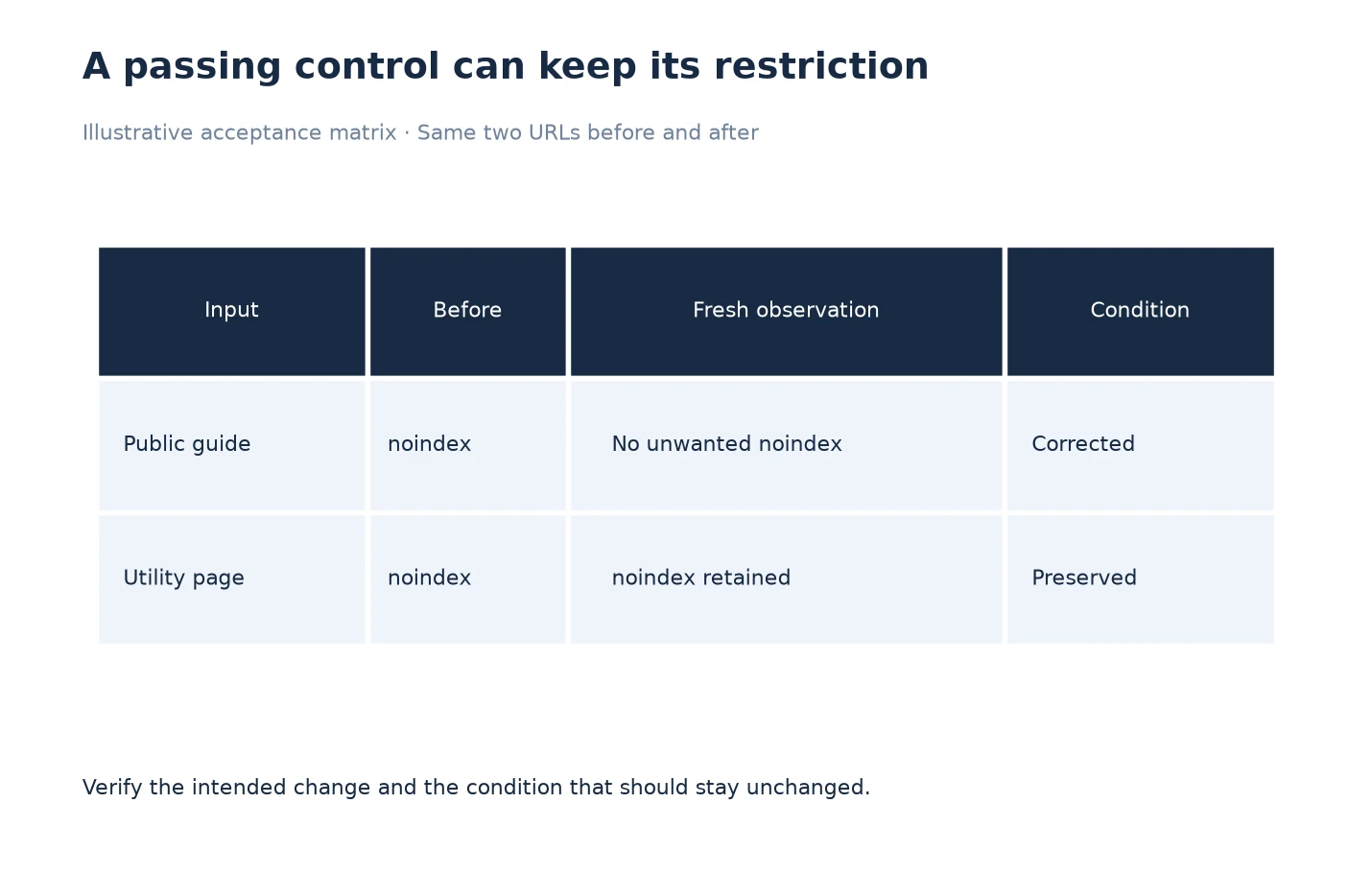
Consider an illustrative two-URL acceptance test. A public guide unexpectedly returns noindex, while a utility page intentionally returns noindex. The approved change applies only to the public guide. Before deployment, both observed responses contain the restriction, but only one is a confirmed policy mismatch.
After deployment, a fresh collection finds the public guide without the unwanted noindex value in the inspected fields. The utility page still contains its intended restriction. The acceptance matrix therefore records the public-guide condition as corrected and the utility-page control as preserved. It does not report that fewer restricted pages automatically means a better site.
If both pages lose the instruction, the original public-page symptom may be resolved but the control fails. The change needs review before the case is closed. This is why an acceptance matrix suits the task: it displays whether each intended condition holds, including the condition that should stay unchanged.
If the guide cannot be fetched, mark that condition unresolved rather than passed. If only the local draft changed, mark deployment unverified. The example’s two rows and outcomes are teaching data; they are not a product benchmark, a ranking prediction or evidence that a search engine has already processed the correction.
Keep Technical Verification Separate From Search Processing
A fresh LLMIC observation can support a statement about the live source or page response collected at that time. It does not establish when a search engine revisited the page or how it will treat the URL. If the business question requires that second outcome, add a separately dated search-engine observation instead of extending the local evidence beyond its scope.
This distinction improves reporting. You can accurately close a deployment defect while recording search processing as a separate follow-up, or leave the technical issue open because collection failed. Neither case requires an invented waiting period or a promise that the corrected page will rank. State the observation you have and the decision it supports.
Record the Result So It Can Be Rechecked
Build a short change record with baseline time, deployment reference, fresh collection time, input identity, expected condition, observed result and reviewer. Link the underlying source and exported rows. A future operator should be able to reproduce the test without reconstructing the original conversation or guessing which screenshot belonged to which environment.
Use exporting robots evidence to package the record. Keep the original files and the interpreted worksheet separate. If the correction is rolled back or a template changes again, this record provides a specific regression test instead of a vague instruction to check robots.
Verification is complete for the stated scope when every required condition has evidence and every exception is explained. Do not expand a two-URL check into a claim about the entire website. Where a shared template affects many pages, add representative variants and reconcile the affected population before making a broader conclusion.
Frequently Asked Questions
Is saving the edited file enough to close the issue?
No. Retrieve the live source or response after deployment and repeat the original test inputs. Saving proves that an artifact changed, not that the website serves it correctly.
Why do I need an unchanged control URL?
It checks that a narrow correction did not remove an intentional restriction elsewhere. A fix can resolve one symptom while creating a neighboring policy mismatch.
Can I use an old crawl for the after result?
Use fresh collection for the changed condition. An old saved crawl is useful baseline evidence but cannot establish the response served after deployment.
What if the after crawl cannot fetch the page?
Mark the page-level condition unresolved and investigate retrieval. A missing observation cannot verify that an instruction disappeared or that the page now behaves as intended.
Does removing noindex guarantee a search result?
No. The local test can establish the observed instruction change. Search-engine processing and inclusion require separate evidence and remain outside that local acceptance claim.
Should I retest every agent after one change?
Choose agents and paths affected by the intended policy and its likely boundaries. Expand the test set when the change touches shared or agent-specific rules, and document the scope actually checked.
What should a final verification statement say?
Name the tested inputs, fresh observation time, passed conditions and remaining limitations. Avoid declaring the whole website fixed when the evidence covers only a defined subset.
Sources, Statistics and Measurement Notes
The collection and inspection boundaries were checked against LLMIC source on 5 October 2026. The two-page acceptance matrix is an original illustrative test, not measured customer data. It deliberately preserves an intentional restriction as a passing control condition.
Google Search Central’s robots documentation supplies the external distinction between crawl management and search inclusion. This guide’s acceptance process does not promise when Google will process a website change.