
Verify Changes to Crawl Speed in LLMIC
Test duration and reliability against the same required workload.
A configuration change reduces a crawl from ten minutes to seven. Before calling it an improvement, check whether both runs inspected the same URLs, performed the same required checks and produced comparable usable evidence. A shorter run can be less complete.
Verify changes to crawl speed in LLMIC with a fixed workload, explicit acceptance conditions and repeated observations when practical. Measure useful completion alongside elapsed time and failures. The decision should be whether the change improves the defined investigation, not whether one displayed speed value became larger.
Write the Acceptance Conditions First
Name the input set and the required completion stage. State which rendering or analysis steps must remain enabled. Identify the important URLs that cannot be omitted, and define how unresolved requests will be reported.
Add a reliability condition appropriate to the task. Do not invent a universal acceptable error percentage. The owner of a production release check may require usable evidence for every critical URL, while an exploratory run may tolerate documented gaps that remain open for follow-up.
Choose the comparison measure before seeing the result. This prevents a team from switching between peak speed, total duration and filtered completion counts until one makes the candidate configuration look favorable.
Save a Baseline That Can Be Repeated
Preserve the original crawl, input list and settings. Record the date, elapsed duration, completion counts and failures that the evidence actually supports. If the baseline was interrupted, keep that limitation visible.
Use a bounded URL List for a configuration experiment when possible. A linked crawl can change its workload as discovery progresses, which makes a speed comparison harder to interpret. Keep a separate test if linked-discovery behavior itself is part of the requirement.
Record local and external conditions that could materially affect the comparison. Another application consuming resources, a changed website deployment or a different server-load period can confound the result. You do not need perfect laboratory control, but you do need honest boundaries around the conclusion.
Change One Relevant Variable
Select the candidate setting based on the diagnosis. If errors appeared after concurrency increased, test a lower value with the other required settings unchanged. If the issue concerns an unnecessary enrichment check, document why removing it preserves the original audit’s purpose.
Do not change concurrency, rendering, input membership and required checks together and attribute the outcome to one control. A combined change can be tested as a package, but its individual contribution remains unknown.
Alternate or repeat baseline and candidate runs when the decision warrants it and the website owner permits the request load. Repetition helps expose ordinary variability. It does not justify unlimited testing against a production site that is already under pressure.
Compare Completion Before Duration
| Acceptance question | Evidence needed | Result to keep open |
|---|---|---|
| Was the same population tested? | Input identity and important URL membership | Candidate omitted required pages |
| Were the same checks performed? | Rendering and analysis settings | Faster run removed necessary evidence |
| Did useful work finish? | Defined completion outcomes | Failed or unavailable observations hidden from totals |
| Was duration meaningfully different? | Comparable elapsed times and repeated observations where appropriate | One unexplained outlier |
| Did reliability deteriorate? | Recorded failures and relevant server responses | More failures despite a shorter duration |
A candidate must first satisfy the investigation’s completeness requirements. Only then does its duration become a useful comparison. Otherwise the experiment may be measuring how quickly it can stop doing part of the job.
Worked Example: Compare Three Matched Runs
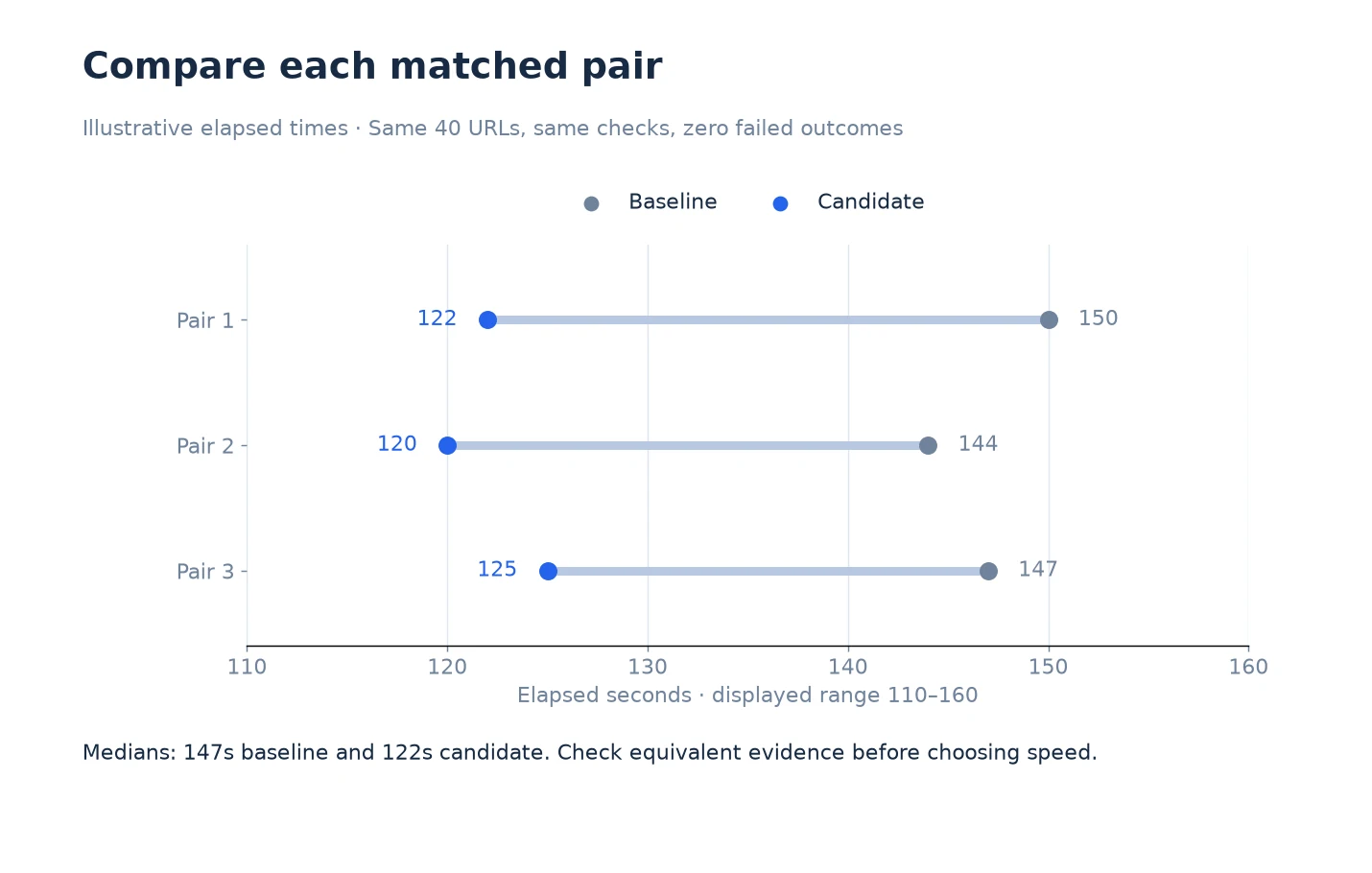
Each horizontal connector joins one baseline run to its matched candidate. The repeat pairs have no time-order story, so a connected time-series line would imply a relationship the experiment does not establish. Read the labelled endpoints, then confirm equal useful results and failures before preferring the shorter duration.
This chart is illustrative. Three baseline runs of the same forty-URL workload take 150, 144 and 147 seconds. Three candidate runs take 122, 120 and 125 seconds. In this teaching scenario, all six runs produce the required forty usable observations with no failed outcomes.
The paired values show a consistent duration difference across these constructed repetitions. The median baseline duration is 147 seconds and the median candidate duration is 122 seconds. That arithmetic describes only the example; it is not an expected improvement for LLMIC customers.
The reviewer also inspects the required page evidence rather than trusting the count alone. Forty rows containing the wrong content would not satisfy the acceptance condition. If one candidate run had omitted a critical page, the team would investigate it before selecting the configuration.
The chart names the matched runs and keeps the zero baseline on the duration axis. The caption states the shared population and outcome assumptions, allowing readers to see why the time comparison is meaningful in this example.
Investigate an Inconsistent Result
If the candidate is faster once and slower twice, inspect the conditions before averaging away the inconsistency. Check workload identity, errors, page mix and relevant local or server events. Report the individual observations so a reviewer can see the variation.
If a faster candidate has more failed outcomes, distinguish performance from reliability. A retry plan may be part of the total work, so measure the time needed to obtain the required evidence rather than stopping the clock at the first incomplete attempt.
When the difference is small relative to observed variability, avoid a strong improvement claim. The practical decision may be to keep the simpler or more reliable configuration until a larger or better-controlled test provides useful evidence.
Record the Decision and Its Limits
State the selected setting, tested workload, repeated observations and acceptance outcomes. Describe the conditions under which the choice should be reconsidered, such as a change in page templates, rendering requirements or server behavior.
Keep rejected candidates in the experiment record with their observed limitations. This prevents someone from repeating the same unsupported speed increase later because the reason for rejecting it disappeared from the handoff.
Do not convert a local configuration test into a claim about Google crawling, rankings or indexing. It establishes how your investigation performed under the recorded conditions. Search-engine processing remains a separate question with separate evidence.
For a reusable setup, return to Configure Crawl Speed in LLMIC. Use Export Crawl Speed Evidence From LLMIC to preserve the matched-run results and the calculations supporting the decision.
Questions About Speed Verification
What makes two runs comparable?
They need a defined common workload, matching required checks and clearly recorded settings. Relevant differences in local or server conditions should be disclosed rather than ignored.
Is one faster run enough to change the configuration?
It may justify a further test, but it can also reflect ordinary variation. Repeat when the decision matters and the request load is appropriate. Keep the individual results visible.
Should I include failed requests in the report?
Yes. Record their outcomes and the unresolved evidence they represent. Excluding them after the run can make an incomplete configuration look faster than a complete one.
Can I compare a rendered run with an HTML-only run?
You can describe two different workloads, but do not attribute their time difference solely to a speed setting. Confirm which evidence the original task requires before choosing between them.
Why use a fixed URL List for the experiment?
It provides an explicit population to reconcile. Linked discovery may add different URLs across runs, so a fixed list often makes a configuration comparison easier to interpret.
What if the candidate saves time but misses an important page?
The completeness condition remains failed or unestablished for that case. Investigate the missing evidence before accepting the configuration, even if the total duration is attractive.
Does a successful test apply to every website?
No. The conclusion is bounded by the tested inputs, page mix, Mac, server conditions and required checks. Reconsider it when those conditions change materially.
Sources, Statistics and Measurement Notes
The matched-run chart uses synthetic durations and an explicitly assumed forty-URL workload. Medians are calculated from the three values stated for each configuration. These are teaching calculations, not a product benchmark, measured customer gain or universal recommendation.
The procedure uses LLMIC input and configuration controls reviewed on 5 October 2026. No Google crawling or search-performance outcome is inferred from the local acceptance test.