
Review Canonical Signals Results in LLMIC
Distinguish intentional mappings from mismatches and unknowns.
A canonical finding contains at least two questions: what does the source declare, and what evidence exists for its target? Those questions should be answered before deciding whether a relationship is intentional, inconsistent or unresolved. An issue name is a starting point for that review, not a complete explanation of the site’s content policy.
This guide interprets LLMIC canonical findings through a source-and-target worksheet. It shows how to separate declaration defects from target problems and collection gaps, then choose a proportionate next action. The review stays within the evidence collected by the application and does not claim to reproduce a search engine’s canonical selection.
Begin With the Actual Source Row
Open the affected page and identify its collected URL, observation time and extracted canonical value. Compare those fields with the original input when redirects or parameter handling may have changed the identity. A label attached to one collected page cannot automatically explain every variant that led an operator to that page.
Read the issue’s evidence and current value. The reviewed detector can identify a missing extracted declaration, more than one tag, different targets among those tags, a relative value or a fragment. Each category asks for a different check. Avoid combining them into a generic canonical error count before inspecting what the rows actually contain.
For a multiple-tag finding, retain the markup containing the declarations. The simplified value displayed in one column may not represent every target found in the source. A reviewer needs the competing elements to determine whether two systems emitted the same value or different values. Those situations can share a cleanup task but imply different levels of ambiguity.
Decide Whether the Relationship Is Intended
Compare the declared target with the owner’s preferred URL for that content group. A Canonicalised finding means the observed relationship points away from the current page under the detector’s URL comparison. It does not establish that the relationship is unwanted. An intentional variant and an unrelated page accidentally pointing elsewhere require different decisions.
Inspect content identity before accepting a cross-page relationship. Read the source and target enough to understand whether they serve the same underlying material or distinct user needs. Do not infer equivalence merely because titles overlap or both pages belong to the same product category. Record the owner’s rationale where the relationship is deliberate.
Use a distinct control page from the same template. If it points to the same target as many unrelated sources, investigate a shared configuration error rather than treating each row as an independent editorial decision. Grouping by template can make the repair efficient, but preserve the individual URLs needed to verify the resulting change.
Read Target Findings as Evidence Boundaries
The reviewed detector checks a target against page records available in the crawl context. When a stored target is non-indexable or has a response status at or above 300, it can produce a Non-Indexable Canonical finding. Inspect the target’s actual row and reason instead of translating the issue name into an unsupported diagnosis such as target deleted.
Canonical Unlinked is especially easy to overread. In the reviewed implementation, it can mean that an internal, non-self target was not found in the crawl context. That is not proof that the target lacks all internal links, does not exist or returns an error. Scope, discovery and collection history can explain why the record is absent.
| Finding family | What to inspect | Decision boundary |
|---|---|---|
| Missing or malformed declaration | Source markup and extraction evidence | Confirm what was actually available to inspect |
| Multiple declarations | Every relevant tag and target | Separate duplicate output from conflicting output |
| Canonicalised | Declared and intended target | Intentional relationship versus policy mismatch |
| Non-Indexable Canonical | Saved target status and indexing evidence | Identify the specific target condition |
| Canonical Unlinked | Scope and target collection coverage | Unknown target state versus observed failure |
If the target is external or not collected, leave its current state unverified until you obtain appropriate evidence. The absence of a detector warning must not be presented as proof that every external target was fetched successfully.
Worked Example: Six Sources, Three Different Conclusions
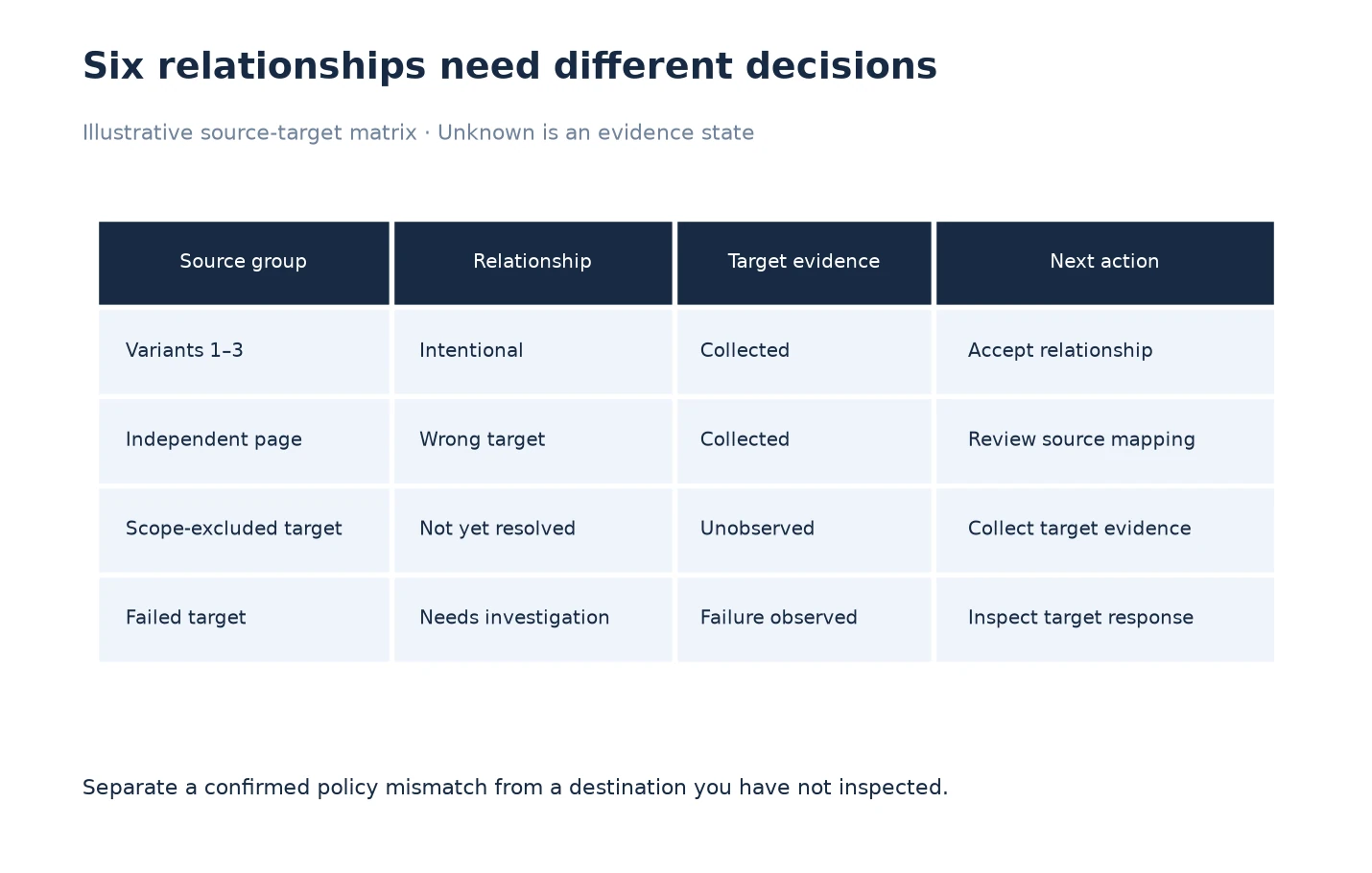
Imagine an illustrative review of six source URLs. Three are intentional variants pointing to a collected preferred page. One unrelated source points to that page by mistake. One source declares an internal target that was excluded from the crawl scope. The final source points to a collected target with a failing observed response.
There are six relationships to review, but they do not produce six equivalent defects. The three intentional variants need a documented acceptance decision. The unrelated source needs a policy correction. The absent target needs additional observation. The failing target needs investigation of the response and intended destination.
A relationship matrix is useful here because it can display the source’s intent and the target’s evidence side by side. A single severity bar would conceal the distinction between a known mismatch and an unknown target. The example deliberately leaves one row unresolved instead of inventing a target status to complete the chart.
The next action for the scope-excluded target is to collect or otherwise inspect it under authorized conditions. If that fresh observation is healthy and matches the intended relationship, the coverage question is resolved without changing the website. A reduction in warnings caused by better evidence should be described as improved coverage, not as a repaired server response.
Reconcile Counts Before Reporting Them
Count affected source URLs separately from issue instances. One source can have multiple findings, such as a relative declaration and a problematic target. Adding those issue totals and calling the sum affected pages exaggerates the population. Retain a unique source count and use separate totals for the categories when both are useful.
Also distinguish sources from unique targets. Ten variants can declare the same destination, so a target-level fix may affect many source relationships. That does not make ten targets broken. A report that preserves this distinction helps the owner estimate the actual change surface and choose representative verification cases.
Keep your denominator tied to the collected population. If the review inspected 50 HTML pages from a larger website, label the result accordingly. Do not extend a local subset into a site-wide prevalence claim, especially when the omitted pages include other templates or external canonical destinations.
Write an Action With a Verifiable End State
A useful action names the source group, intended target and the specific observed condition to change. For example, an independent article emitted an unrelated target from a shared template. The verification can then check that article and neighboring template variants after deployment. A request to improve canonical SEO provides no equivalent acceptance condition.
Use canonical troubleshooting when the declaration or target evidence remains inconsistent. Prepare the handoff with canonical evidence exports. Keep unresolved observations visible until the recipient has enough evidence to decide whether a website change is needed.
Frequently Asked Questions
Does Canonicalised mean the page must become self-canonical?
No. Review whether it is an intentional variant. The relationship is a finding to interpret against the content policy, not an instruction to make every page point to itself.
Does Canonical Unlinked prove there are no internal links?
Not from that label alone. In the reviewed detector it can reflect a target absent from the crawl context. Inspect scope and collection evidence before making a linking claim.
Is every target fetched automatically for verification?
Do not assume that. The reviewed target checks use available crawl records. Mark an uncollected or external target unverified until separate evidence establishes its current state.
Why are issue totals larger than the source count?
A source URL can trigger more than one finding. Report unique affected sources separately from issue instances so overlapping categories do not inflate page counts.
Should repeated identical canonical tags be ignored?
Inspect their source and record the duplication. Repeated identical output differs from conflicting targets, but both deserve a clear explanation of which system emits the markup.
Can a target warning identify the exact server defect?
Read the saved target status and evidence. The category groups several conditions and does not by itself establish whether the cause is a redirect, restriction, failure or collection problem.
What proves a review is ready for action?
Each proposed change should connect an observed condition to the owner’s intended relationship, with the relevant source and target evidence available for verification.
Sources, Statistics and Measurement Notes
Finding behavior was reviewed in CanonicalIssueDetector on 5 October 2026. The six-source matrix is an invented teaching example with explicit intentional, mismatched, unobserved and failed states. Its counts are not measured website or customer results.
Google Search Central’s canonical reference provides the broader canonicalization context. This review method does not equate LLMIC’s local classifications with a Google-selected canonical.