
Verify Changes to Canonical Signals in LLMIC
Accept a correction through source, target and control checks.
A canonical correction is more than a new value in a settings screen. The intended source must emit the intended relationship, the target must have relevant fresh evidence, and neighboring pages must retain their own correct behavior. Verification should establish those conditions without claiming that a local crawl determines which URL a search engine will select.
This guide turns the original canonical finding into a bounded acceptance test. It preserves source and target identities, compares compatible observations and keeps unresolved conditions visible. You will finish with a record of what changed on the website and what the collected evidence can actually support.
Define the Change in Terms of a Relationship
Write the original source URL, observed target and intended target before collecting the after result. Identify whether the correction addresses a wrong relationship, conflicting output, a malformed declaration or a target condition. These are different acceptance questions even when they appear in the same issue group.
Name the system that was changed and retain the deployment reference. A template correction may affect many sources, while a page-level setting may affect only one. The verification population should follow that change surface. Do not test one convenient page and extend the conclusion to every template variant without evidence.
Choose a control relationship that should stay unchanged. An intentional parameter variant is useful when correcting an unrelated page that inherited the same target. A separate template variant may be useful when removing duplicate output. The control makes it possible to detect a broad change that resolves the original warning but damages a legitimate relationship.
Keep the Before and After Inputs Comparable
Preserve the baseline crawl, source markup, relevant target records and collection settings. Use the same original inputs for the after test, including meaningful query parameters. Record redirects and collected identities so a changed destination does not silently replace the source you intended to verify.
Keep access conditions and rendering mode comparable where they affect the document. If a new collection method is necessary, explain why and separate the resulting evidence improvement from the website change. Otherwise, a tag appearing in one run but not another could reflect different collection rather than corrected production output.
Retain failed baseline observations as part of the record. If the original target was absent from scope and is now collected, describe that as resolved coverage unless the website itself also changed. The distinction matters because a reduction in findings can come from better evidence without representing a repaired canonical relationship.
Inspect the New Source Output
Fetch the affected page after deployment and inspect the relevant declaration. For a conflicting-tag repair, confirm the actual resulting markup rather than accepting the first extracted value. For a malformed-value repair, confirm the literal output and its resolved destination. The test should address the original symptom directly.
When the case involves source and rendered output, preserve each observation separately. Do not overwrite the baseline artifact with the new one or reuse an old screenshot to illustrate the after state. A complete evidence chain needs the collected document, method and time for each side of the comparison.
If the source cannot be retrieved, the source-output condition remains unresolved. A newly configured value in the CMS does not replace the missing production observation. Record the retrieval issue and investigate it before marking the canonical correction accepted.
| Condition | Passing evidence | Keep unresolved when |
|---|---|---|
| Source output | Fresh declaration matches the approved relationship | Only a local setting or draft is available |
| Declaration consistency | Relevant markup no longer contains the original conflict | Only one extracted field was inspected |
| Target observation | Intended destination has current, relevant evidence | Destination was outside scope or inaccessible |
| Control relationship | Unchanged page retains its intended mapping | Control was omitted from the after test |
| Reporting scope | Conclusion names tested inputs and limits | A sample is presented as the entire website |
Check the Target as a Separate Observation
Open or collect the intended target under the appropriate authorized conditions. Record its current identity, response and relevant page evidence. A source pointing to a new address is not enough to establish that the destination is available or represents the intended content.
If the target redirects, retain the observed destination and review it against the approved relationship. If it cannot be collected, do not infer a healthy target from the absence of a local issue. An unobserved target remains a limitation of the acceptance record, especially when it lies outside the original crawl boundary.
Inspect content relevance as well as technical fields. A reachable target can still be the wrong representative for an independent source. The owner-approved relationship is therefore part of the test input, not something inferred automatically from a successful response code.
Worked Example: Correct an Article Without Changing Its Variant
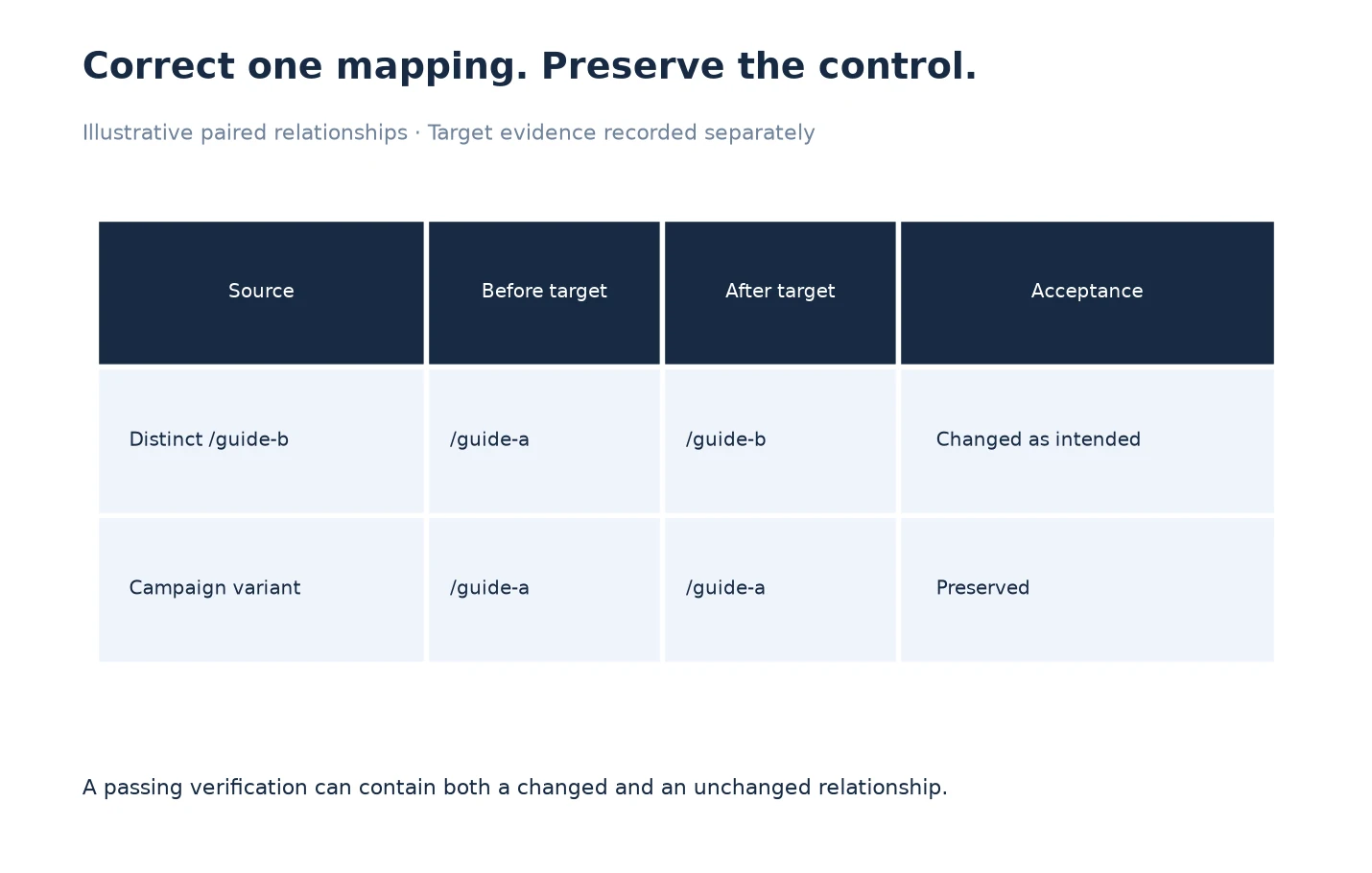
In an illustrative case, a distinct article at /guide-b incorrectly declares /guide-a because of a shared template setting. A campaign variant of /guide-a intentionally declares /guide-a. The approved correction changes only the distinct article to its own intended target while preserving the campaign relationship.
The before-and-after matrix has two source rows. For /guide-b, the declaration changes from /guide-a to /guide-b. For the campaign variant, the declaration remains /guide-a. Fresh target observations are linked separately. Both rows can pass even though only one target value changes.
If the campaign variant also switches to an unintended value, the control fails. The original article may look corrected, but the shared-template change needs review. This example shows why fewer non-self relationships is not a useful acceptance target by itself: an intentional variant is supposed to continue pointing elsewhere.
If the article’s new target was never collected, mark target verification incomplete. The source-output change may be confirmed while the overall acceptance remains partial. A matrix can express those separate states without turning them into a misleading single success score.
Separate Website Correction From Search Selection
The local verification establishes what was collected from the website at the recorded time. If the task also asks which canonical Google selected, attach a separately sourced search-engine observation and its date. Do not relabel an extracted declaration as Google-selected simply because the value matches the owner’s preference.
A deployment can be technically verified before a later search observation is available. Report those as separate milestones. Avoid invented processing deadlines or a promise that the corrected page will gain traffic. The acceptance record should be useful even when the search outcome remains outside the evidence currently available.
Save a Regression Case for the Next Release
Keep the source URLs, expected relationships, target references and control cases in a small worksheet. Add the deployment reference, baseline time, after time and reviewer decision. This turns a one-time repair into a repeatable check for future template or SEO-configuration changes.
Package the record using canonical evidence exports. If any condition fails, return to canonical troubleshooting with the preserved inputs. Close the task only for the scope actually tested, and leave unobserved variants or external targets clearly identified.
Frequently Asked Questions
Does a new CMS value prove the change is live?
No. Inspect fresh production output after deployment. The saved setting is evidence of configuration, while the collected page establishes what the website actually emitted.
Why verify a relationship that should not change?
A control can reveal collateral effects from shared templates or settings. It protects intentional mappings while the affected source is corrected.
Is checking one canonical column enough for a conflict repair?
Inspect the relevant markup containing the declarations. A single extracted value may not establish that competing output was removed.
What if the new target is outside the crawl scope?
Collect or inspect it separately under authorized conditions, or retain an unverified target condition. Do not treat source-output success as complete destination verification.
Can fewer Canonicalised findings prove improvement?
Not on their own. Intentional variants can correctly point elsewhere. Verify the approved relationships rather than optimizing the count toward zero.
Does this test confirm Google’s selected canonical?
No. That requires separately sourced search-engine evidence. Keep the site’s declaration, the owner’s intention and the search observation distinct in the report.
What should I retain for future regression testing?
Keep exact source inputs, expected targets, control relationships, collection conditions and the accepted evidence. Those details allow another release to repeat the same checks.
Sources, Statistics and Measurement Notes
The acceptance boundaries reflect LLMIC’s CanonicalIssueDetector and page export source reviewed on 5 October 2026. The two-source matrix is a constructed example, not a customer result or a claim about search-engine processing time.
Google’s canonicalization documentation provides the external distinction between site signals and canonical selection. The regression worksheet and paired relationship checks here are original operational guidance.