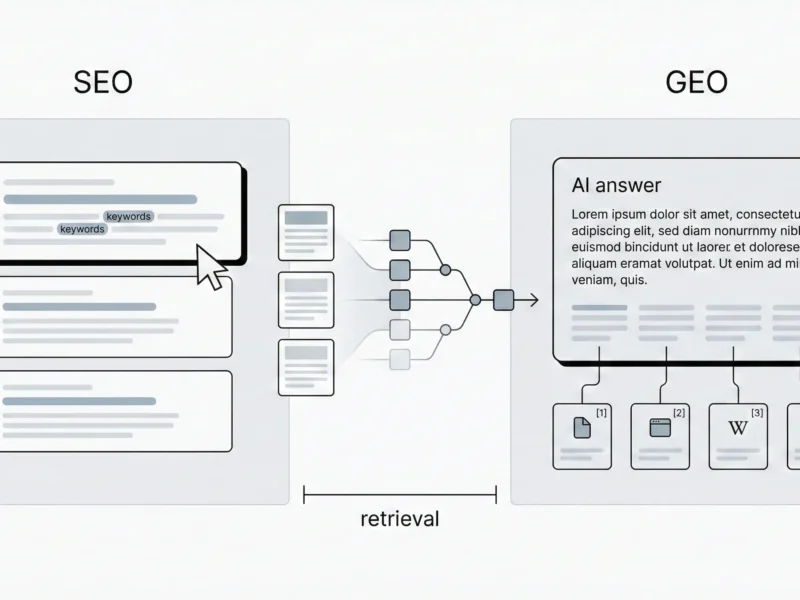

Code to text ratio is becoming more important in the AI engines era because search is moving from links to answers. Google AI Overviews, AI Mode, ChatGPT Search, and Perplexity all need to find, read, extract, and trust page content fast.
Code to text ratio means the balance between visible text and the code used to display a web page. It is not a direct ranking factor by itself. Still, it can affect crawlability, rendering, page speed, user experience, and AI citation readiness.
That is why it matters now.
A page with clean HTML, useful text, fast loading, and clear structure gives search engines and AI systems less noise to process. A page with too much code and too little useful text may look rich to users, but harder for machines to understand.
What Is Code to Text Ratio?
Code to text ratio is the percentage of readable page text compared with the total HTML code on a page. In simple words, it asks this question: how much of the page is useful content, and how much is code, wrappers, scripts, styles, and layout?
Here is the simple formula:
| Item | Meaning |
|---|---|
| Text | Visible words users can read |
| Code | HTML, CSS, JavaScript, inline styles, scripts, tags, and layout code |
| Ratio | Visible text divided by total page code |
A clean page does not need a “perfect” code to text ratio. Instead, it needs enough useful content that is easy to find in the HTML or rendered page.
Is Code to Text Ratio a Direct SEO Ranking Factor?
No, code to text ratio is not confirmed as a direct Google ranking factor.
However, that does not make it useless.
It works more like a warning light. If a page has very little visible content and a huge amount of code, something may be wrong. The page may be slow. The main answer may be buried. The HTML may be noisy. The content may be thin. The page may depend too much on JavaScript.
So, code to text ratio matters because it connects to real ranking and visibility signals.
These include:
- crawlability
- indexing
- page speed
- Core Web Vitals
- content clarity
- structured data quality
- user experience
- AI answer extraction
This is the key point: code to text ratio is not the ranking signal. But the problems behind a poor ratio can hurt SEO.
Why It Matters More in the AI Engines Era
AI engines do not only rank pages. They summarize them.
That changes the job of SEO.
In classic SEO, your goal was to rank and earn the click. In AI search, your goal is also to become a trusted source inside an answer. That means your page must be easy to parse, quote, verify, and connect to an entity or topic.
Google says AI Overviews and AI Mode use normal Search systems and supporting links. It also says pages must be indexed and eligible to show a snippet to appear as supporting links in these AI features.
OpenAI also has OAI-SearchBot for surfacing websites in ChatGPT search features. PerplexityBot is also designed to surface and link websites in Perplexity search results.
So, AI visibility still starts with machine access.
If a crawler or AI search system has to work through bloated code, render-heavy scripts, weak headings, thin content, and unclear markup, your page becomes harder to use as a source.
That is why clean code and strong visible text now matter more.
The Data Behind Code Bloat
The web is getting heavier.
HTTP Archive’s 2025 Web Almanac reported that the median mobile home page reached 2.6 MB in 2025. The median desktop home page reached 2.9 MB. It also reported that the median mobile home page grew 202.8% from July 2015 to July 2025.
JavaScript is also growing. The 2024 Web Almanac reported that median JavaScript payload reached 558 KB on mobile and 613 KB on desktop. That was a 14% rise.
At the same time, median HTML document size was much smaller. In 2024, the median HTML transfer size was 32 KB on mobile and 33 KB on desktop.
This gap matters.
Many modern pages load far more script than readable content. That can make pages slower, harder to render, and more complex for crawlers.
Here is the simple view:
| Data Point | Reported Figure |
|---|---|
| Median mobile home page size in 2025 | 2.6 MB |
| Median desktop home page size in 2025 | 2.9 MB |
| Mobile home page growth from 2015 to 2025 | 202.8% |
| Median mobile JavaScript payload in 2024 | 558 KB |
| Median desktop JavaScript payload in 2024 | 613 KB |
| Median mobile HTML transfer size in 2024 | 32 KB |
| Median desktop HTML transfer size in 2024 | 33 KB |
The lesson is clear. Code is growing faster than useful content on many websites.
Code to Text Ratio and Crawlability
Search engines first need to crawl your page.
If your important content is easy to find in HTML, crawlers can process it faster. If the main content only appears after heavy JavaScript rendering, discovery can become more complex.
Google explains that JavaScript pages are processed in three phases:
- Crawling
- Rendering
- Indexing
That means JavaScript content can still be indexed. But it adds another step.
This is why server-side rendering, clean HTML, crawlable links, and clear content blocks still matter. They reduce friction.
For AI engines, this is even more important. AI systems need to extract clean passages. They need to see the answer, the headings, the facts, and the context.
A better code to text ratio helps because the useful content is not hidden under layers of technical noise.
Code to Text Ratio and Core Web Vitals
A poor code to text ratio often means more scripts, more CSS, more third-party tags, and more layout work.
That can hurt Core Web Vitals.
Core Web Vitals measure real user experience. The main metrics are:
| Metric | Good Score |
|---|---|
| Largest Contentful Paint | 2.5 seconds or less |
| Interaction to Next Paint | 200 milliseconds or less |
| Cumulative Layout Shift | 0.1 or less |
Code bloat can affect all three.
Heavy JavaScript can delay interaction. Large CSS can delay rendering. Unstable ad slots or layout shifts can hurt visual stability. Extra third-party scripts can block the main thread.
So, code to text ratio is not just an SEO number. It is also a performance clue.
If a page has 700 KB of JavaScript and only 400 words of visible content, you should ask why.
Code to Text Ratio and AI Citation Readiness
AI engines prefer content that is easy to quote.
That does not mean they only read plain HTML. But clean content helps.
A citation-ready page usually has:
- a clear answer near the top
- short paragraphs
- meaningful H2 and H3 headings
- useful facts
- source-backed claims
- clean schema
- readable text
- fast loading
- crawlable links
- low technical noise
This is where code to text ratio supports GEO, or generative engine optimization.
AI systems need passages that stand alone. They also need enough context to know what the page is about. If your page is thin, vague, or hidden behind complex scripts, it may not be the best source.
A clean page gives AI engines a better chance to understand your content.
The Click Problem Makes AI Visibility More Valuable
AI search is also changing user behavior.
Pew Research Center found that users who saw a Google AI summary clicked a traditional search result in 8% of visits. Users who did not see an AI summary clicked a traditional result in 15% of visits.
Pew also found that users clicked a link inside the AI summary in only 1% of visits. In addition, 26% of visits with an AI summary ended the browsing session, compared with 16% of visits without one.
This means fewer users may click through when AI answers appear.
So, your content has two jobs now:
- Rank well enough to be found.
- Be clean enough to be used as a source.
Code to text ratio helps with the second job because it makes your content easier to extract and understand.
What a Good Code to Text Ratio Looks Like
There is no official perfect code to text ratio.
Do not chase a fixed number like 25%, 40%, or 70% without context. A product page, calculator, news article, tool page, and landing page will all have different needs.
Instead, use this practical rule:
Your page should have enough useful visible content to answer the search intent, while keeping the code needed to deliver that content as lean as possible.
A healthy page usually has:
- visible content in the HTML or rendered HTML
- short and clean markup
- limited inline styles
- compressed HTML, CSS, and JavaScript
- reduced unused CSS and JavaScript
- clean heading order
- crawlable internal links
- structured data in JSON-LD
- no hidden main content
- no excessive DOM depth
A poor page often has:
- too many wrappers
- too many page-builder blocks
- large scripts for simple content
- thin visible text
- hidden tabs with core answers
- bloated tracking code
- unused CSS
- unclear headings
- no meaningful schema
- slow rendering
How to Improve Code to Text Ratio for SEO
You do not need to delete all code. You need to remove waste.
Here is how to do it.
1. Put the Main Answer in Visible HTML
Place the core answer near the top of the page. Use plain text. Do not hide it behind tabs, sliders, accordions, or JavaScript-only blocks.
For example, if the page is about “code to text ratio,” define it in the first 100 words.
This helps users, search engines, and AI engines.
2. Reduce Unused JavaScript
Audit scripts that do not support the page goal.
Remove old plugins. Delay non-critical scripts. Use smaller libraries. Avoid loading site-wide JavaScript on pages that do not need it.
This can improve speed and reduce crawl friction.
3. Reduce Unused CSS
Large CSS files often come from themes, builders, and design systems.
Remove unused styles where possible. Minify CSS. Load critical CSS first. Avoid loading every design rule on every page.
Cleaner CSS helps pages render faster.
4. Use Server-Side Rendering Where Needed
If your content depends on JavaScript, make sure crawlers can still see it.
Server-side rendering or static rendering can help important content appear faster and more reliably.
This matters most for blogs, product pages, category pages, documentation, and local landing pages.
5. Clean Your HTML Structure
Use simple, semantic HTML.
Use one H1. Use H2s and H3s in order. Use paragraphs for text. Use lists for steps. Use tables for comparisons. Use descriptive anchor text.
Do not wrap every sentence in several nested divs if simple markup can do the job.
6. Add Structured Data Carefully
Google recommends JSON-LD for structured data when a site setup allows it. JSON-LD is easier to implement and maintain at scale.
For articles, use Article schema. For FAQs, use FAQPage schema where it fits your site and current search eligibility. For organizations, use Organization schema.
Structured data will not fix weak content. But it can help machines understand your entities, page type, and relationships.
7. Compress and Minify Files
Compression matters.
HTTP Archive found that about 10.5% of mobile HTML documents in 2024 were still served without compression. That is a missed chance.
Use Brotli or Gzip compression. Minify HTML, CSS, and JavaScript. Remove comments and unused code from production files.
Small changes can add up.
Code to Text Ratio Audit Checklist
Use this checklist before publishing or updating a page.
| Check | Good Sign |
|---|---|
| Main answer appears early | Yes, within the first 100 words |
| Page has enough useful text | Yes, it fully answers the query |
| HTML is clean | Yes, limited bloat and clear structure |
| JavaScript is needed | Yes, not loaded without purpose |
| CSS is controlled | Yes, unused styles are reduced |
| Core Web Vitals are healthy | LCP, INP, and CLS pass |
| Structured data is valid | JSON-LD is tested |
| Links are crawlable | Important links use proper anchor tags |
| Content is extractable | The page works without heavy friction |
| Page is AI-friendly | Clear headings, facts, and direct answers |
Common Mistakes to Avoid
The biggest mistake is treating code to text ratio like a magic ranking score.
It is not.
The second mistake is ignoring it fully. That is also risky.
A low ratio may show deeper problems. For example, your page may be built with a heavy theme, too many plugins, or weak content. It may load many scripts before showing the main answer.
Another mistake is removing useful design or features only to improve a percentage. That can hurt users.
The goal is balance.
Keep the code that improves the page. Remove the code that slows, hides, or confuses the content.
Did You Know?
In 2025, HTTP Archive reported that the median mobile home page was 2.6 MB, while the 2024 median mobile HTML document was only 32 KB. This shows how much page weight often comes from resources beyond the core document, including JavaScript, CSS, images, fonts, and third-party files.
Conclusion
Code to text ratio is not a direct ranking factor, but it is one of the most useful SEO health signals in the AI engines era.
It helps you spot code bloat, weak content, slow rendering, and poor machine readability. More importantly, it supports the things that search engines and AI systems already care about: crawlability, speed, structure, useful content, and clear answers.
The future of SEO is not only about ranking. It is also about being selected, summarized, and cited.
That is why code to text ratio matters for AI search SEO.
References
- https://developers.google.com/search/docs/appearance/ai-features
- https://developers.google.com/search/docs/crawling-indexing/javascript/javascript-seo-basics
- https://developers.google.com/search/docs/appearance/page-experience
- https://developers.google.com/search/docs/appearance/core-web-vitals
- https://web.dev/articles/vitals
- https://developers.google.com/search/docs/appearance/structured-data/intro-structured-data
- https://blog.google/products-and-platforms/products/search/ai-overviews-search-october-2024/
- https://developers.openai.com/api/docs/bots
- https://docs.perplexity.ai/docs/resources/perplexity-crawlers
- https://almanac.httparchive.org/en/2025/page-weight
- https://almanac.httparchive.org/en/2024/javascript
- https://almanac.httparchive.org/en/2024/markup
- https://www.pewresearch.org/short-reads/2025/07/22/google-users-are-less-likely-to-click-on-links-when-an-ai-summary-appears-in-the-results/
- https://www.searchenginejournal.com/ranking-factors/code-to-text-ratio/
Frequently asked questions
Code to text ratio is the balance between visible page text and the HTML code used to build the page. It helps show whether a page has enough useful content compared with its technical markup. It is not a direct ranking factor, but it can reveal SEO problems.
Code to text ratio is not confirmed as a direct Google ranking factor. However, poor code quality, slow page speed, thin content, and rendering problems can affect SEO. So, the ratio is useful as a technical audit signal.
AI engines need to read, extract, summarize, and cite content. Clean code and clear visible text make this easier. A page with strong answers, simple structure, and less code bloat is easier for AI systems to understand and use as a source.
There is no official perfect code to text ratio. A good page should have enough visible content to answer the search intent and only the code needed to support the experience. Focus on clean HTML, fast loading, clear headings, and useful content instead of chasing one fixed percentage.
You can improve it by removing unused JavaScript and CSS, compressing files, using clean HTML, placing the main answer near the top, reducing page-builder bloat, and adding valid structured data. Also test Core Web Vitals and make sure important content is crawlable.