

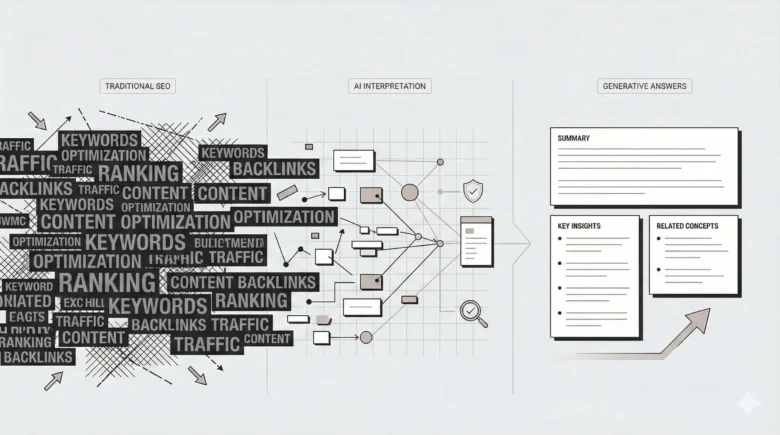
Search is no longer just about ranking on Google.
Today, people ask questions directly to AI tools like ChatGPT, Google AI Overviews, Gemini, and Perplexity. Instead of seeing ten blue links, they get one clear answer.
That shift is exactly why Generative Engine Optimization, or GEO, exists.
What Is Generative Engine Optimization?
Generative Engine Optimization (GEO) is the process of optimizing content so that AI-powered answer engines can understand it, retrieve it, trust it, and use it while generating answers.
In simple words:
- SEO helps pages rank
- GEO helps content get used by AI
If an AI can safely rely on your content, it may quote you, summarize you, or cite you directly in its response.
And that visibility often happens before a user ever clicks a website.
Why Traditional SEO Is No Longer Enough
Traditional SEO was built for search engines that show links.
Generative engines work very differently.
They:
- Read content deeply
- Break it into chunks
- Compare meaning, not keywords
- Choose only the most reliable sources
Here’s the difference at a glance:
| Traditional SEO | Generative Engine Optimization |
|---|---|
| Focuses on rankings | Focuses on retrieval and usage |
| Optimizes for clicks | Optimizes for answers |
| Keyword-driven | Meaning and entity-driven |
| Page-level optimization | Sentence and fact-level optimization |
This doesn’t mean SEO is dead.
It means SEO is no longer sufficient on its own.
How Generative Engines Actually Use Content
To understand GEO, you need to understand how AI engines work at a high level.
Most modern AI search systems use something called Retrieval Augmented Generation (RAG).
The flow looks like this:
- User asks a question
- AI retrieves relevant content from trusted sources
- Content is broken into chunks
- Best chunks are selected based on meaning and trust
- AI generates an answer using those chunks
Your content doesn’t need to “rank #1”.
It needs to be:
- Clear
- Fact-based
- Easy to quote
- Semantically complete
What GEO Optimizes For (Core Principles)
Generative Engine Optimization focuses on a different set of signals than classic SEO.
1. Clarity Over Cleverness
AI prefers:
- Simple language
- Direct explanations
- Declarative sentences
Flowery writing hurts retrieval.
2. Facts Over Fluff
AI systems actively try to avoid hallucinations.
That’s why they prefer content that includes:
- Verifiable facts
- Numbers
- Clear definitions
- Stable explanations
3. Entities Over Keywords
Instead of repeating keywords, GEO focuses on:
- Clear entities (people, concepts, technologies)
- Relationships between entities
- Consistent terminology
4. Answer-First Structure
AI engines love content that answers questions early.
The faster your content delivers value, the higher its retrieval potential.
Did You Know?
- According to Microsoft, over 30% of Bing searches now involve AI-generated responses
- Google confirmed that AI Overviews pull content from multiple sources, not just top-ranking pages
- OpenAI has stated that clarity and factual consistency reduce hallucination risk in AI outputs
These systems are actively looking for trustworthy reference content, not marketing copy.
What GEO Is Not
There’s a lot of confusion around this, so let’s clear it up.
GEO is NOT:
- Keyword stuffing for AI
- Writing prompts for ChatGPT
- Hiding content inside schema
- Chasing every AI tool separately
GEO is about making your content usable by machines without hurting human readability.
If a human can understand it easily, and an AI can trust it, you’re on the right path.
Who Should Care About GEO?
GEO matters if you are:
- A SaaS brand
- A publisher
- An education platform
- A healthcare or finance website
- A knowledge-heavy business
- Anyone who depends on informational traffic
If users can ask questions related to your domain, AI engines will try to answer them — with or without you.
GEO decides whether you are part of that answer.
How GEO and SEO Work Together
This is important.
GEO does not replace SEO.
It builds on top of it.
Think of it like this:
- SEO gets your content discovered
- GEO gets your content selected
Strong technical SEO, clean site structure, and authority still matter. GEO simply ensures that your content survives the AI interpretation layer.
Summary: Generative Engine Optimization in One Minute
Generative Engine Optimization is about making your content:
- Understandable to AI
- Safe to quote
- Rich in facts
- Structured for answers
- Built around entities, not keywords
As search moves from links to answers, being cited matters more than being clicked.
And GEO is how you make that happen.
