
Quick Summary
If you only remember a few things, remember these:
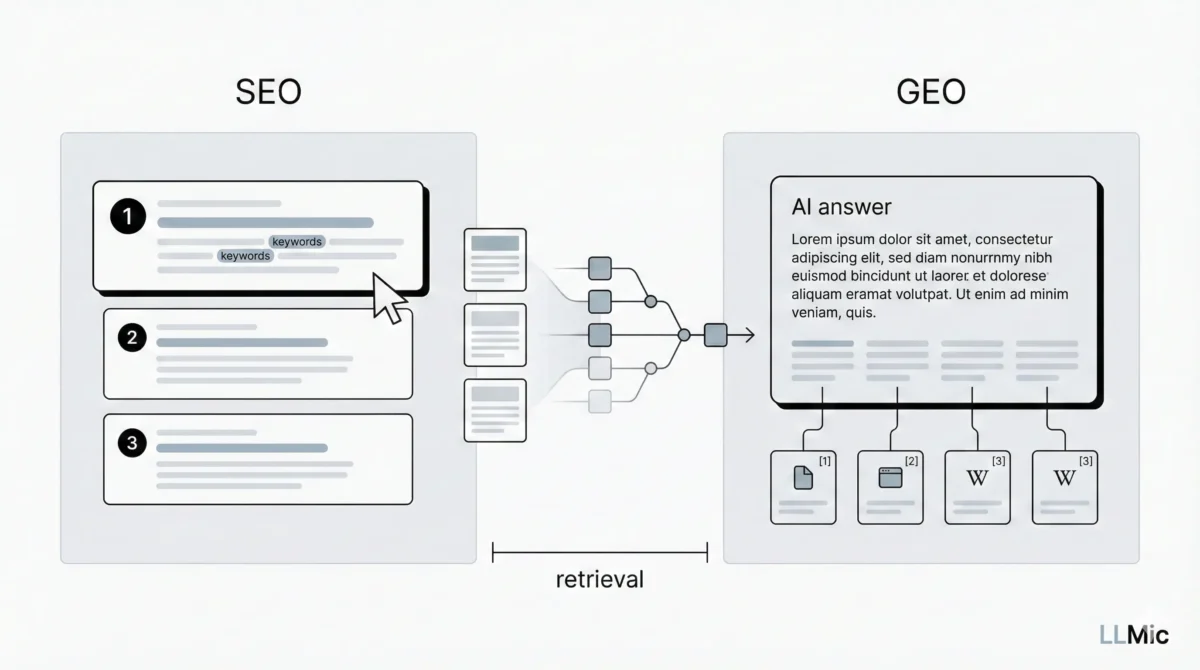
SEO helps your page rank. GEO helps your content get used in AI answers.
Traditional search is ranking-first. AI search is retrieval-first.
Clicks are no longer the only “win.” Sometimes the win is being cited or summarized.
Keywords still matter, but entities and clarity matter more.
The best GEO strategy is not to abandon SEO. It’s to upgrade it so your content survives the AI layer.
When people hear “GEO,” they usually assume one of two things:
- “This is just SEO with a new name.”
- “SEO is dead, so I must do GEO now.”
Both are wrong.
SEO is still a major foundation. But the interface of search is changing, and that changes what “optimization” means.
Here’s the easiest way to understand it:
SEO is like trying to get your shop placed on the busiest street.
GEO is like trying to become the shop the local guide recommends when someone asks, “Where should I go?”
One is about placement.
The other is about selection.
And selection is where AI search changes the game.
The world SEO was built for
Classic search engines behave like librarians.
You ask a question. The librarian points you to a few books (links). You choose which one to open.
In this world:
- Rankings matter because they decide visibility.
- Titles and meta descriptions matter because they influence clicks.
- Backlinks matter because they signal authority.
Now imagine a different world.
The world GEO is built for
Generative engines behave like a helpful friend who reads a stack of books for you and then explains the answer in simple language.
You ask a question. The system reads multiple sources, pulls out the best parts, and gives you one answer.
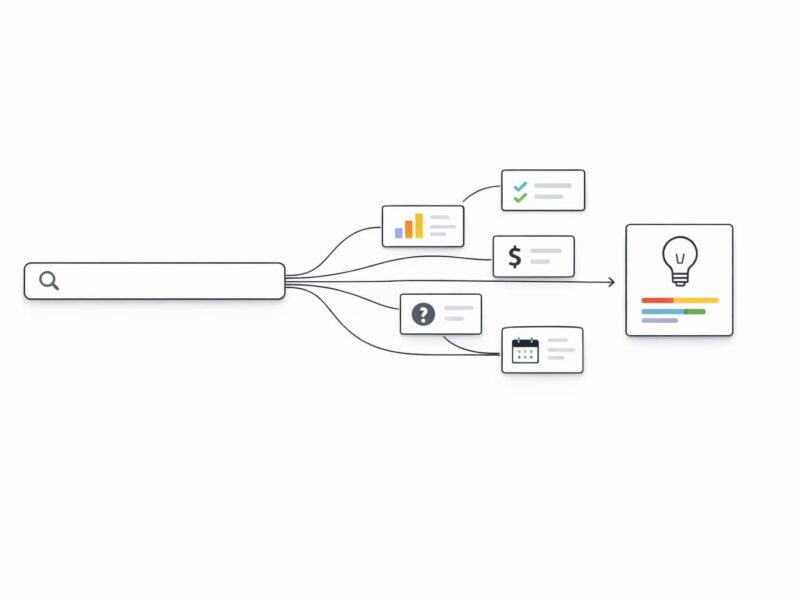
Google’s own documentation explains that AI Overviews and AI Mode may use a “query fan-out” approach: the system runs multiple related searches across subtopics and sources to build a response.
That matters because you’re not competing only for rank anymore.
You’re competing to be included in what the AI chooses to read and reuse.
That’s GEO.
GEO vs SEO in one clean comparison
| What you’re optimizing for | SEO | GEO |
|---|---|---|
| Primary goal | Higher rankings | Inclusion in generated answers |
| Main battleground | SERP positions | Retrieval + selection layer |
| Success signal | Clicks and traffic | Mentions, citations, influence, qualified clicks |
| Content focus | Pages | Passages, chunks, micro-answers |
| Language focus | Keywords | Entities, definitions, relationships |
| Quality focus | Relevance and authority | Clarity, trust, verifiability, quote-worthiness |
Now let’s break down the three key shifts you asked for, with real-world examples.
1) Ranking vs retrieval: what changes, really?
SEO thinking: “How do I rank this page for a keyword?”
GEO thinking: “How do I make my content the safest, clearest piece for an AI to use?”
What is “retrieval” in plain English?
Retrieval is when an AI system goes out and fetches relevant content before answering.
It’s like asking three friends:
- “What’s the best phone under ₹30,000?”
- They quickly read 10 articles.
- Then they give you a short, confident recommendation.
Your job in GEO is to make your content easy to retrieve and easy to trust.
That means:
- Your key statements should be easy to find.
- Your definitions should be explicit.
- Your comparisons should be structured.
- Your facts should be verifiable.
Real-world example: “Best phone under ₹30,000”
In classic SEO, you write an article:
- “Top 10 phones under ₹30,000”
- You add specs, images, long intros, fluff, affiliate sections, and a big conclusion.
- You aim for ranking and clicks.
In GEO, the engine might not care about your long intro.
It may retrieve only a few passages, such as:
- “Battery size and real-world backup”
- “Processor performance”
- “Camera in low light”
- “Software update policy”
- “Best value pick and why”
So the content that gets used is often:
- structured
- direct
- fact-dense
- easy to quote
Here’s the uncomfortable truth:
Your page can rank well and still be useless to a generative engine if the useful information is buried.
And your page can rank modestly yet still get used if it has the clearest, most reusable passage.
That’s the ranking vs retrieval shift.
A quote to remember
Traditional SEO fights for position. GEO fights for selection.
2) Clicks vs answers: why “visibility without traffic” is real
In classic search:
- Visibility usually equals clicks.
- And clicks equal traffic.
- And traffic equals business outcomes (if you convert).
In generative search:
- Visibility can happen inside the answer.
- Sometimes the user never clicks.
- Sometimes the user clicks fewer times, but with higher intent.
Google itself has described this mixed behavior.
Google has said that with AI Overviews, people are searching more and asking longer, more complex questions. They also note that for some quick-answer queries, users may be satisfied without clicking further.
At the same time, Google has also said they see clicks from pages with AI Overviews as “higher quality,” with users more likely to spend more time on the site.
So the reality is not “AI kills all clicks.”
The reality is:
- Some queries become zero-click.
- Some clicks become fewer but better.
What this means for you?
If you’re running a bakery:
- SEO is trying to get people to visit your shop.
- GEO is trying to get your bakery recommended when someone asks, “Where can I get the best sourdough nearby?”
That recommendation might give:
- your name
- your specialty
- your location
- your hours
- a link
Sometimes the person walks in without clicking anything (because they already trust the answer).
Sometimes they click to verify menu or pricing.
Either way, being part of the answer is influence.
Practical KPI shift: how you measure success
SEO KPIs tend to be:
- impressions
- clicks
- rankings
- organic sessions
- CTR
GEO KPIs tend to be:
- AI citations or mentions (when measurable)
- AI referral traffic (ChatGPT/Perplexity/Gemini referrals)
- brand searches uplift (people searching your name after seeing you in answers)
- conversions from fewer but higher-intent visits
- inclusion rate for target questions
This is why GEO is not only “more content.”
It’s different packaging for the same content so it can survive AI summarization.
Important context: AI search is expanding
Reuters reported that Google tested an AI-only version of search (“AI Mode”) that replaces the traditional list of links with an AI-generated summary and cited links, available initially through Google’s paid plan in an experimental rollout.
That’s another signal that answers will increasingly sit in front of links.
So you want your content to be the kind of content those answers are built from.
3) Keywords vs entities: the shift from “phrases” to “things”
This is the part that sounds technical, but it’s actually easy.
A keyword is a phrase.
An entity is the thing the phrase refers to.
Example:
- “Apple” (keyword) could mean a fruit or a company.
- “Apple Inc.” (entity) is specific.
- “Apple fruit nutrition” (entity context) is specific.
Generative engines hate ambiguity. If they’re not sure what you mean, they either skip your content or misinterpret it.
That’s why entity clarity matters.
Real-world example: “best jaguar”
If someone types “best jaguar,” what do they mean?
- the best Jaguar car?
- the best jaguar (animal) documentary?
- the best jaguar zoo in India?
In SEO, you might create a page and try to rank for the term.
In GEO, you try to avoid ambiguous content and make your page clearly about one entity:
- Jaguar (car brand)
- Jaguar (animal)
- Jaguar conservation programs
Your headings, definitions, and examples must lock the meaning.
How you write for entities without sounding robotic
You don’t need to spam terms.
You need to define and connect them.
A simple entity-friendly pattern looks like this:
- One-sentence definition
- Two or three supporting facts
- A quick example
- Common confusion or misconception
- A short summary
This is why FAQ formats, “what it is / how it works / why it matters” formats, and glossary formats work well in AI search.
They reduce ambiguity.
They increase quote-worthiness.
They make retrieval easier.
Why GEO exists (the real reason)
Here’s the honest reason GEO became a thing:
AI models can be wrong.
OpenAI describes hallucinations as cases where a model confidently generates something untrue, and they point out that common training and evaluation setups can reward guessing instead of admitting uncertainty.
So AI systems look for signals that reduce risk, such as:
- clear definitions
- stable facts
- consistent terminology
- credible sources
- structured explanations
GEO is the discipline of making your content safer to reuse.
Not by hiding text. Not by gaming prompts.
By being clearer and more verifiable.
The “mode switch” a beginner can understand
If you’re explaining this to a non-tech person, use this analogy.
Traditional SEO is like:
- Writing a book
- Trying to get it placed on the front table in a bookstore
GEO is like:
- Writing a book
- And also writing a clear summary page that makes it easy for someone else to explain the book accurately in 30 seconds
Generative engines are summarizers by design.
Your job is to make their summarization accurate.
That’s GEO.
A practical example: turning a normal SEO page into a GEO-ready page
Let’s say you have a page titled:
“GEO vs SEO”
In classic SEO, you might write:
- a long intro
- a history of SEO
- some opinions
- a conclusion
In GEO, you keep the intro short, and you add retrieval-friendly structure.
Here’s a simple upgrade path:
Step 1: Put the answer near the top
Add a short section early:
- “SEO optimizes for ranking. GEO optimizes for inclusion in AI answers.”
Step 2: Add a comparison table
Tables work well because they chunk meaning cleanly.
Step 3: Add one real-world example per concept
Examples reduce misinterpretation.
Step 4: Add definitions of key terms
Define:
- retrieval
- entity
- answer engine
- citation
- chunk
Step 5: Add fact anchors
You don’t need a research paper.
You need a few credible, stable facts.
For example, Google has stated that AI Overviews is driving over a 10% increase in usage for queries that show AI Overviews in major markets like the U.S. and India.
That kind of stat makes your content feel grounded.
Step 6: Remove fluff that wastes attention
GEO rewards clarity.
If a paragraph doesn’t teach something, cut it.
Did you know (GEO reality checks)
- Google says AI Overviews is driving over a 10% increase in usage for queries that show AI Overviews in major markets like the U.S. and India.
- Google says AI Overviews leads to more complex searches and more links shown, while some quick-answer queries may end without a click.
- Google advises publishers that clicks from results pages with AI Overviews can be higher quality, with users spending more time on site.
- Google’s Search Central documentation explains AI responses may use “query fan-out” across subtopics and sources.
- OpenAI explains hallucinations happen when models confidently output false content, and training/evaluation can reward guessing over uncertainty.
These points are the practical reason GEO exists: AI is powerful, but it needs reliable inputs.
Where LLMic fits?
If GEO is the strategy, then tools like LLMic help you execute it consistently.
A human can read a page and say, “This feels clear.”
But at scale, you want to audit things like:
- Is the main definition present early?
- Are headings structured logically?
- Are there answer-ready passages?
- Is content overly bloated?
- Are entities clear and consistent?
This is exactly the kind of gap GEO tools are designed to solve.
Not by “doing SEO for you,” but by helping you make content AI-ready without guessing.
Common misunderstandings (so you don’t waste time)
Misunderstanding 1: “If I rank #1, AI will always use me.”
Not always.
AI systems may use multiple sources, and retrieval can surface passages from pages that aren’t top-ranked if they’re clearer or more directly relevant. Google’s documentation emphasizes that its AI features can identify supporting pages while generating responses.
Misunderstanding 2: “GEO is just adding schema.”
Schema helps clarify entities, but GEO is bigger than that.
If your content itself is unclear, schema can’t rescue it.
Misunderstanding 3: “GEO means writing for robots.”
Bad GEO writing feels robotic.
Good GEO writing feels like a helpful human.
It’s just structured so machines can also read it.
The simplest way to think about GEO vs SEO
Here’s the mental model I recommend:
SEO decides whether you get discovered.
GEO decides whether you get reused.
You want both.
Because the future is not “search or AI.”
The future is search plus AI layered on top.